LLM_based_12

5.7k 词

复杂推理(思维链)

原理

进阶推理

CoT作为草稿提供中间步骤 + 验证机制进行审计

  • 步骤变长后,误差可能累积
  • 事后编造
  • 对提示敏感
  • 为推理:看起来合理但实际不对
  • token/时延成本增加

结构化CoT

A:Plan-and-Solve:列计划再逐步执行,减少跳步。
B:Least-to-Most:先解最简单子问题,逐步递进。先从确定性最强的子问题出发,逐步收缩推理空间,适合多约束任务。

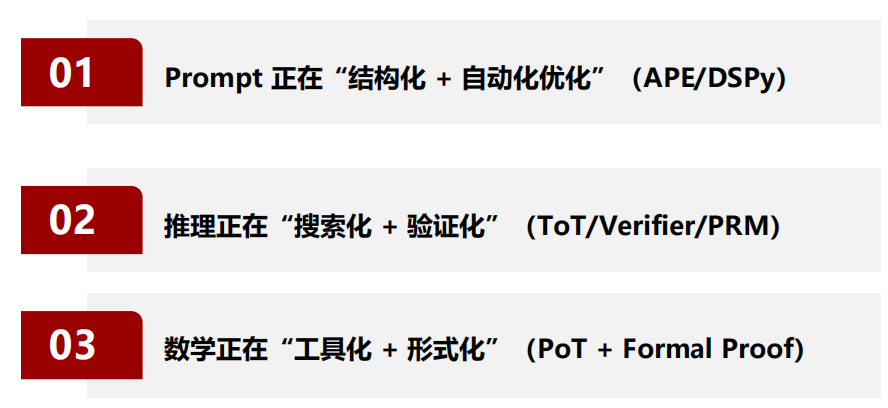
ToT与多路径探索

相当于优化问题:多分支推理 + 分步评估 + 回溯选择

同一个问题同时探索多个候选思路(分支),每走几步就评估质量,不行就剪枝/回溯,再探索别的分支

工具调用 / ReAct思路

推理 - 行动(调用实际工具)- 更新修正

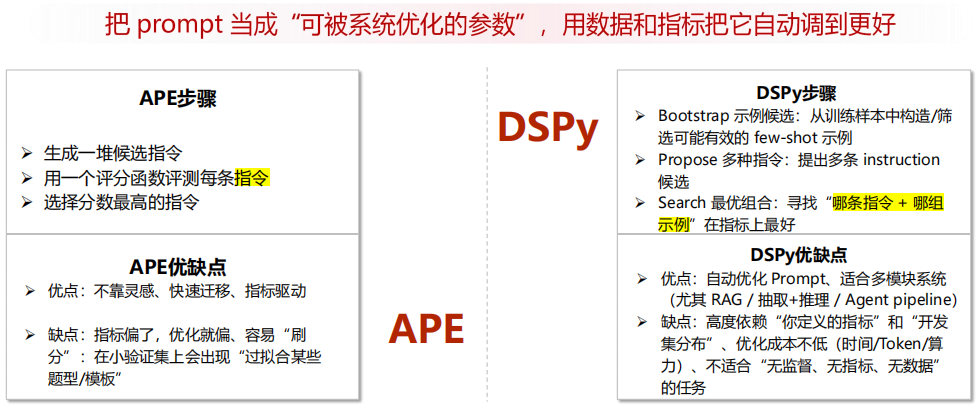
Prompt自动化

数学推理

PoT

把不擅长的环节交给擅长的工具:求 LLM在遇到需要精确计算的任务时,先生成一段可执行的程序(通常是 Python 代码或计算表达式),然后把计算交给解释器/计算器执行,再把执行结果组织成最终答案。

  • 语义理解错误
  • 代码生成错误

解决

  • 强制分两段输出:可执行代码+最终答案

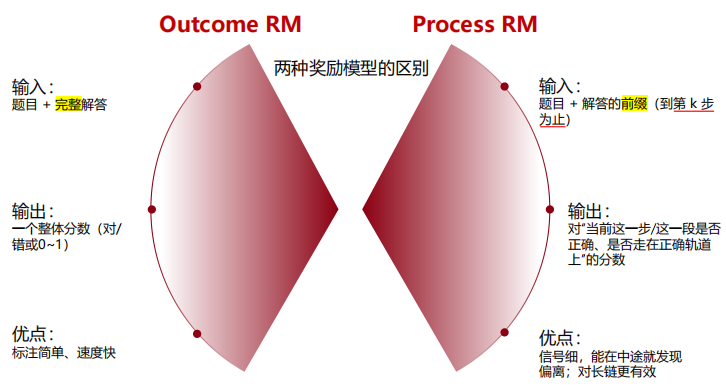
PRM

过程监督 / 验证器

形式化数学

题目、定义、引理、证明步骤写成证明器(proof assistant)能理解的严格语言(例如Lean 等),然后由证明器做逐步类型检查/逻辑检查

存在问题

  • 数据污染/背题
  • 泛化问题,表述更换性能下降
  • 成本增加

垂直领域

要求

  • 可追溯(Traceable):结论必须能“指回证据”
  • 可验证(Verifiable):关键步骤必须能“复核”
  • 可控(Controllable):输出要稳定、结构要可控、边界要清楚

方法

  • 转换成结构化对象
  • 硬推理
  • LLM读懂并抽取和解释输出,核心判断交给可验证的推理测

蒸馏:让强模型(Teacher)把“怎么推理”的过程写出来(分步解释/计算程序/中间结论),再用这些“推理轨迹(reasoning traces)”去监督微调小模型(Student),把推理能力迁移过去

代码

思维链

使用HuggingFace

在线状态

import os
os.environ['HF_ENDPOINT'] = 'https://hf-mirror.com'

离线/集群状态

  • 先在有网的机器把模型下载到某目录(HF cache)。
  • 集群离线时设置:
    • export HF_HOME=/path/to/hf_cache
    • export TRANSFORMERS_OFFLINE=1
    • from_pretrained(MODEL_ID, local_files_only=True)

导包

1
2
3
4
5
import os, re, math, random
import torch
import pandas as pd
from transformers import AutoTokenizer, AutoModelForSeq2SeqLM
from transformers import AutoTokenizer, AutoModelForCausalLM

加载模型 + 数据准备

使用Qwen2.5-0.5B-Instruct

prompt模板(3)

  • direct answer:最终答案
  • CoT:逐步推理,中间推理显式化
  • Self-Consistency:采样多条CoT,多数投票
1
2
3
4
5
6
7
8
9
10
11
12
def prompt_direct(q:str)->str:
return f"""Solve the problem and give only the final answer as a number.

Question: {q}
Final answer:"""

def prompt_cot(q:str)->str:
# 鼓励分布推理+明确 Final answer
return f"""Solve the problem step by step. At the end, write 'Final answer: <number>'.

Question: {q}
Let's think step by step."""

抽取

1
2
3
4
5
6
7
8
9
10
11
12
13
14
15
16
17
18
19
20
21
22
23
24
25
26
27
28
29
30
31
32
33
34
35
# 输出解析:从模型输出里面抽取最终答案
# 输出解释、单位、标点,用正则规则
def extract_number(text:str)->str:
# 调试打印,方便观察(实际跑大量数据时可注释掉)
# print(f"Extracting from: {text[:100]} ... (truncated)")

# 0) 数字正则:匹配 整数 / 小数
# 说明: [-+]? (可选正负) \d+ (数字) (?:\.\d+)? (可选小数)
number_pattern = r"[-+]?\d+(?:\.\d+)?"

# 1) 优先抓 fa 后面的数字
pattern_final = r"final\s*answer.*?" + f"({number_pattern})"
matches = re.findall(pattern_final, text, flags=re.IGNORECASE | re.DOTALL)
if matches:
return matches[-1]

# 2) 未找到,抓 a 或者 r 后面数字
pattern_answer = r"(?:answer|result).*?" + f"({number_pattern})"
matches = re.findall(pattern_answer, text, flags=re.IGNORECASE | re.DOTALL)
if matches:
return matches[-1]

# 3) 抓最后一个数字
nums = re.findall(number_pattern, text)
if nums:
return nums[-1]

return ""

# 进行匹配判断
def exact_match(pred:str,gold:str)->bool:
if pred is None:pred=""
if gold is None:gold=""

return pred.strip()==gold.strip()

评测

三种方式

1
2
3
4
5
6
7
8
9
10
11
12
13
14
15
16
17
18
19
20
21
22
23
24
25
26
27
28
29
30
31
32
def run_direct(example):
out = generate_text(prompt_direct(example["question"]), max_new_tokens=64,
do_sample=False # 不采样,使用贪心解码每一步选择概率最大的
)[0]
return out, extract_number(out)
# 返回完整文本和提取出的数字

def run_cot(example):
out = generate_text(prompt_cot(example["question"]),
max_new_tokens=160, # token更多
do_sample=False)[0]
return out, extract_number(out)

def run_self_consistency(example, n_samples=5): # 让模型随机思考5次
outs=generate_text(
prompt_cot(example["question"]),
max_new_tokens=160,
do_sample=True, # 开启随机采样
temperature=0.8,
top_p=0.95,
num_return_sequences=n_samples
)
preds=[extract_number(t) for t in outs]
# 多数投票 (ties 时第一个出现)
counts={}
for p in preds:
# 统计每个答案出现次数
counts[p] = counts.get(p,0)+1
# 找票数最多的
# -[x]:降序排序,票数相同,谁先出现选谁
pred_sc=sorted(counts.items(), key=lambda x:(-x[1],preds.index(x[0])))[0][0]
return outs,pred_sc,preds

评测指标

1
2
3
4
5
6
7
8
9
10
11
12
13
14
rows.append({
"id": ex["id"],
"question": ex["question"],
"gold": gold,
"direct_pred": direct_pred,
"direct_ok": exact_match(direct_pred, gold), # 判断
"cot_pred": cot_pred,
"cot_ok": exact_match(cot_pred, gold),
"sc_pred": sc_pred,
"sc_ok": exact_match(sc_pred, gold),
"direct_text": direct_text[:300],
"cot_text": cot_text[:300],
"sc_samples": "\n---\n".join([t[:200] for t in sc_texts]),
})
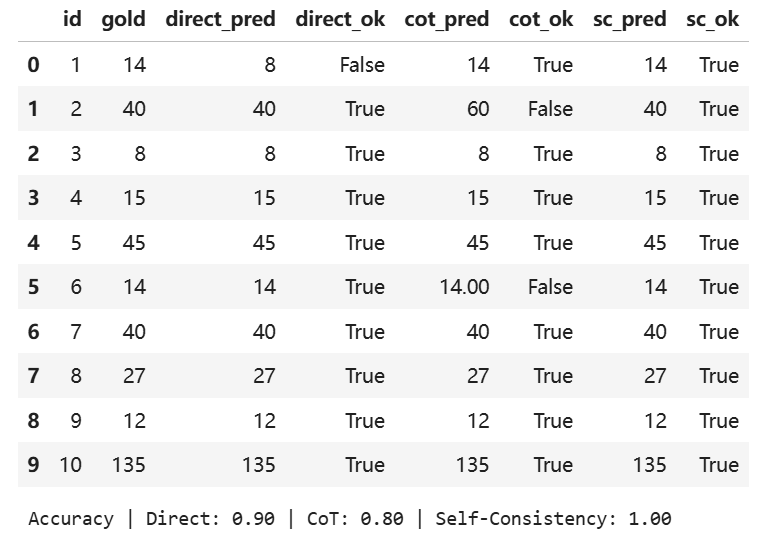
  • Direct:跳步
  • CoT:步骤显式化,难函数拆成多个小函数
  • SC:多条推理共识来抵消采样噪声

验证器和执行器

算术-Python来

在CoT后加一个verifier(规则/执行器/二次模型)来校验最终答案
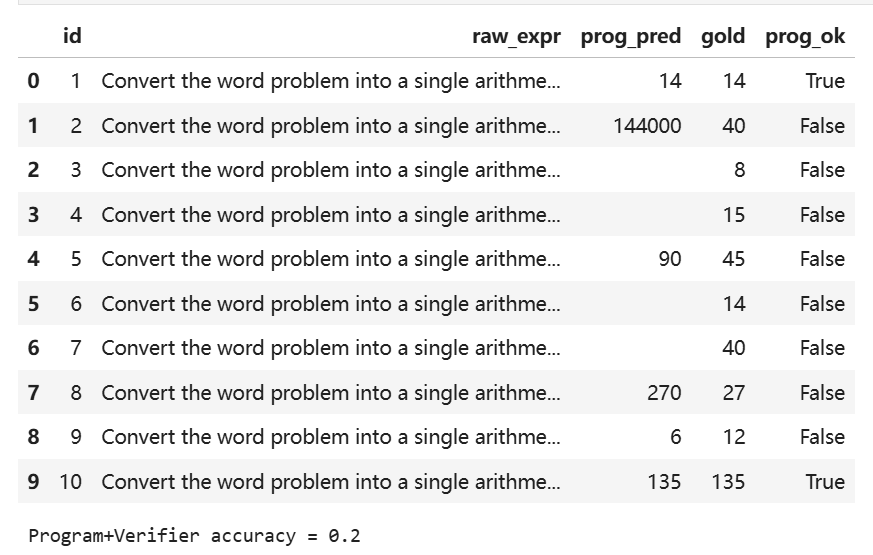
演示:只对纯算术表达式做eval

  • safe_eval_arith(text)
    • 清洗模型输出(去掉 Expression:= 等)
    • 用正则提取合法算术表达式
    • 用安全 eval 计算结果
  • prompt_program(q)
    • 把文字题包装成 Prompt
  • run_program_verifier(example)
    • 执行完整 Program Verifier 流程
      • 调用generate生成
      • 调用safe..计算结果
      • 规范化输出
1
2
3
4
5
6
7
8
9
10
11
12
13
14
15
16
17
18
19
20
21
22
23
24
25
26
27
28
29
30
31
32
33
34
35
36
37
38
39
40
41
42
43
44
45
46
47
48
49
50
51
52
53
54
55
def safe_eval_arith(text:str):
"""
1.文字题转成算术表达式
2.安全计算结果
3.与答案对比
先让模型输出可计算的表达式,再由程序验证。
类 OpenAI 的 PAL
"""
if not text: return None

# 1.预处理:去掉标签
text=text.replace("Expression:","").replace("expression:", "").strip()

# 2.处理 = ,只取左边部分
if "=" in text:
text=text.split("=")[0]

# 3.正则提取:寻找最长的合法算术子串
# 允许字符:数字、小数点、加减乘除、括号、空格
math_pattern = r"[0-9\.\+\-\*\/\(\)\s]+"
matches = re.findall(math_pattern, text)

if not matches:
return None

# 取最长的一段
expr_candidate=max(matches,key=len).strip()

# 安全执行算术表达式,不允许模型输出的其他 Python 代码运行
# 禁掉 Python 内置函数
try:
return eval(expr_candidate,{"__builtins__":{}})
except Exception:
return None

# 问题转换成算术表达式
def prompt_program(q: str) -> str:
return f"""Convert the word problem into a single arithmetic expression using numbers and + - * / parentheses.
Return only the expression.

Question: {q}
Expression:"""

def run_program_verifier(example):
raw_out=generate_text(prompt_program(example["question"]),max_new_tokens=64,do_sample=False)[0].strip()
val=safe_eval_arith(raw_out)
if val is not None:
# 判断整数:做四舍五入,并转成字符串
if abs(val-round(val)) < 1e-6:
pred=str(int(round(val)))
else:
pred=str(val)
else:
pred=""
return raw_out,pred

留言