LLM_based_11

5.9k 词

文本生成任务(翻译+问答)

原理

核心特征

  • 任务约束性
  • 语义一致性
  • 格式规范性

训练

基座预训练 - 任务微调 - 落地适配

  1. 语义对齐预训练
  2. 任务指令微调

挑战展望

  • 幻觉、长文本生成效率、低资源场景适配(数据稀缺)
  • 轻量化、多模态、可控生成、事实增强

代码

调库

1
2
3
4
5
import re
import numpy as np
import torch
import sacrebleu
from transformers import AutoTokenizer, AutoModelForSeq2SeqLM

加载模型

  • 翻译:Helsinki-NLP/opus-mt-en-zh
  • 问答:flan-t5-small

加载,同前,不再赘述。

  • AutoTokenizer
  • AutoModelForSeq2SeqLM
  • model_mt.eval()

统一生成函数

1
2
3
4
5
6
7
8
9
10
11
12
13
14
15
16
17
18
19
20
21
22
23
24
# 通过 temperature/top_p 切换 greedy 与采样
@torch.no_grad()
# top_p:概率截断采样,只从“概率最高的一小部分 token”里随机选
def gen(prompt,model,tok,max_new_tokens=96,temperature=0.0,top_p=1.0):
inputs=tok(prompt,return_tensors='pt',truncation=True).to(device) # 如果太长,自动截断
do_sample=temperature>0 # 随机采样
outputs=model.generate(
**inputs,
max_new_tokens=max_new_tokens,
do_sample=do_sample,
# 温度越低,越稳定,容易被选中;温度越高,随机性越强
temperature=max(temperature,1e-5),
# 核采样:只保留累计概率达到 p 的 token 集合
top_p=top_p,
# 束搜索:每一步保留最优的 k 条路
# 采样模式:不用;非采样模式:保留四路
num_beams=1 if do_sample else 4,
)
# print(outputs)
# print(outputs.shape)
# print(tok.decode(outputs[0]))
return tok.decode(outputs[0],skip_special_tokens=True).strip()

print(gen('translate English to Chinese: The model is robust.', model_mt, tok_mt))

机器翻译(MT)

1
2
3
4
5
6
7
8
9
10
11
12
13
14
15
16
17
18
19
20
21
22
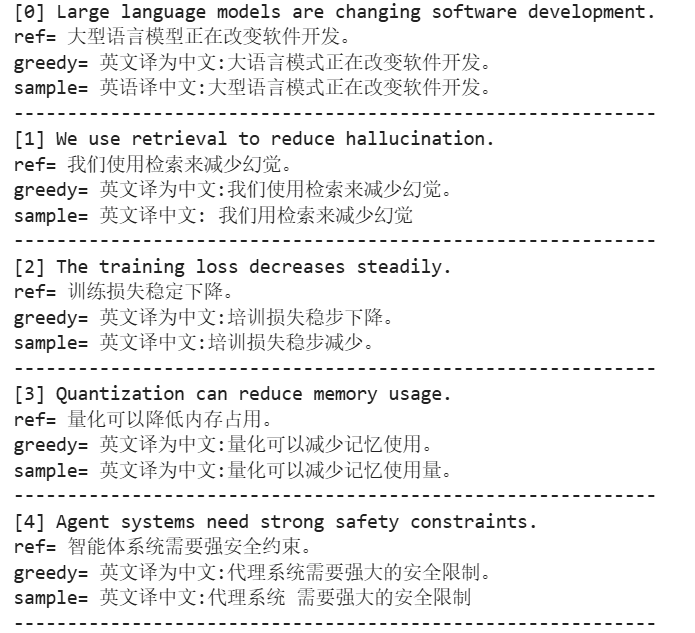
mt_data = [
{"src":"Large language models are changing software development.","ref":"大型语言模型正在改变软件开发。"},
{"src":"We use retrieval to reduce hallucination.","ref":"我们使用检索来减少幻觉。"},
{"src":"The training loss decreases steadily.","ref":"训练损失稳定下降。"},
{"src":"Quantization can reduce memory usage.","ref":"量化可以降低内存占用。"},
{"src":"Agent systems need strong safety constraints.","ref":"智能体系统需要强安全约束。"},
]

# src:原句
# ref:人工参考翻译
def mt_prompt(src):
return f"translate English to Chinese: {src}"

mt_greedy=[gen(mt_prompt(x['src']),model_mt,tok_mt,temperature=0.0)for x in mt_data]
mt_sample=[gen(mt_prompt(x['src']),model_mt,tok_mt,temperature=0.7,top_p=0.9) for x in mt_data]

for i,x in enumerate(mt_data):
print(f"[{i}]", x['src'])
print('ref=', x['ref'])
print('greedy=', mt_greedy[i])
print('sample=', mt_sample[i])
print('-'*60)

BLEU评估

衡量 模型翻译人工标准翻译 的相似程度

  • 计算 n-gram 重合度
  • 缺点:不懂语义

现在流行:

  • ROUGE,摘要
  • METEOR,考虑词形
  • BERTScore,语义相似度
  • COMET,神经网络评估
  • BLEURT,Google 神经评估
1
2
3
refs=[x['ref'] for x in mt_data]
print('BLEU greedy=',sacrebleu.corpus_bleu(mt_greedy,[refs]).score)
print('BLEU sample=',sacrebleu.corpus_bleu(mt_sample, [refs]).score)
1
2
BLEU greedy= 0.0
BLEU sample= 0.0

问答QA

1
2
3
4
5
6
7
8
9
10
11
12
13
14
15
16
17
18
19
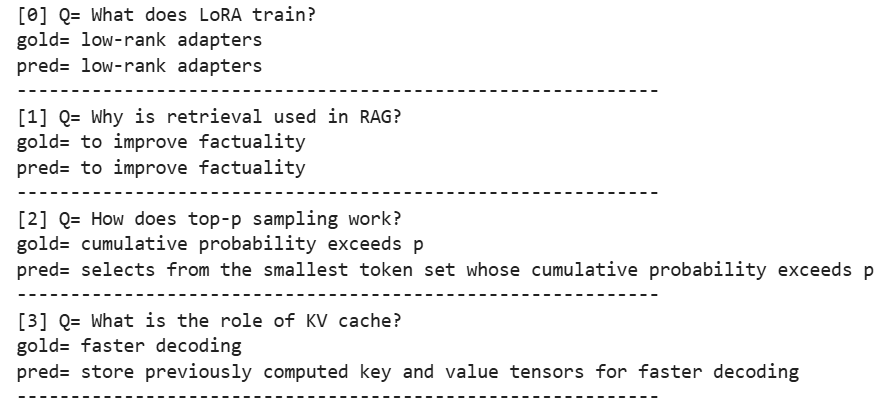
qa_data = [
{"ctx":"LoRA keeps the base model frozen and trains low-rank adapters.","q":"What does LoRA train?","a":"low-rank adapters"},
{"ctx":"RAG retrieves relevant passages before generation to improve factuality.","q":"Why is retrieval used in RAG?","a":"to improve factuality"},
{"ctx":"Top-p sampling selects from the smallest token set whose cumulative probability exceeds p.","q":"How does top-p sampling work?","a":"cumulative probability exceeds p"},
{"ctx":"KV cache stores previously computed key and value tensors for faster decoding.","q":"What is the role of KV cache?","a":"faster decoding"},
]

def qa_prompt(ctx,q):
return (
"Answer the question using the context. If missing, say 'unknown'.\n"
f"context: {ctx}\nquestion: {q}\nanswer:"
)

qa_pred=[gen(qa_prompt(x['ctx'],x['q']),model_qa,tok_qa,temperature=0.0) for x in qa_data]
for i,x in enumerate(qa_data):
print(f"[{i}] Q=", x['q'])
print('gold=', x['a'])
print('pred=', qa_pred[i])
print('-'*60)

EM/Token-F1 评估

  • em:完全匹配
  • f1:部分匹配

50% 的答案完全正确

平均词级重合度是 71.6%

1
2
3
4
5
6
7
8
9
10
11
12
13
14
15
16
17
18
19
20
21
22
23
24
25
26
27
28
29
30
31
32
33
34
35
36
37
38
39
40
def norm(s):
"""
文本标准化:
1.大小写
2.标点
3.多余空格
"""
s=s.lower().strip()
# 英文、数字、中文、空白 -> 替换为空格
s = re.sub(r"[^a-z0-9一-龥\s]", " ", s)
# 多个空格压缩为一个
return re.sub(r"\s+"," ",s)

# 完全匹配
def em(p,g):
return int(norm(p)==norm(g))

# 部分匹配
def f1(p,g):
# 分词
pt,gt=norm(p).split(), norm(g).split()
if not pt and not gt: return 1.0 # 两边都空
if not pt or not gt:return 0.0 # 一边为空
bag={}
# 词袋统计
for t in pt:bag[t] = bag.get(t,0)+1
# 计算交集
inter=0
for t in gt:
if bag.get(t,0)>0:
inter += 1;bag[t]-=1
if inter==0:return 0.0
pre=inter/len(pt) # 准确率-误判:预测里多少是对的
rec=inter/len(gt) # 召回率-漏判:标准答案里多少被找到
return 2*pre*rec / (pre+rec) # F1公式

ems=[em(p,x['a']) for p,x in zip(qa_pred,qa_data)]
f1s=[f1(p,x['a']) for p,x in zip(qa_pred,qa_data)]
print('EM=', 100*np.mean(ems))
print('F1=', 100*np.mean(f1s))
1
2
EM= 50.0
F1= 71.66666666666667

对比QA

1
2
3
4
x=qa_data[3] # 使用 2/3 效果显著
p=qa_prompt(x['ctx'],x['q'])
for cfg in [(0.0,1.0),(0.4,0.9),(0.8,0.95)]:
print(cfg, '->', gen(p, model_qa, tok_qa, temperature=cfg[0], top_p=cfg[1]))

统一任务路由

1
2
3
4
5
6
7
8
9
10
11
12
def run_task(task_type,**kw): # **kw:表示接收任意关键字参数
if task_type == 'translation':
return gen(mt_prompt(kw['source']),model_mt,tok_mt,temperature=kw.get('temperature',0.0))
if task_type == 'qa':
return gen(qa_prompt(kw['context'], kw['question']), model_qa, tok_qa, temperature=kw.get('temperature',0.0))
raise ValueError(task_type)

print(run_task('translation', source='RAG combines retrieval and generation.'))
# ctx未明确给出时
print(run_task('qa', context='MoE activates a subset of experts.', question='How does MoE save computation?'))
# ctx明确给出
print(run_task('qa', context='MoE saves computation by activating only a subset of experts.', question='How does MoE save computation?'))

输出:

1
2
3
英文译为中文:RAG结合检索和生成。
unknown
activating only a subset of experts
留言