LLM_based_17

3.1k 词

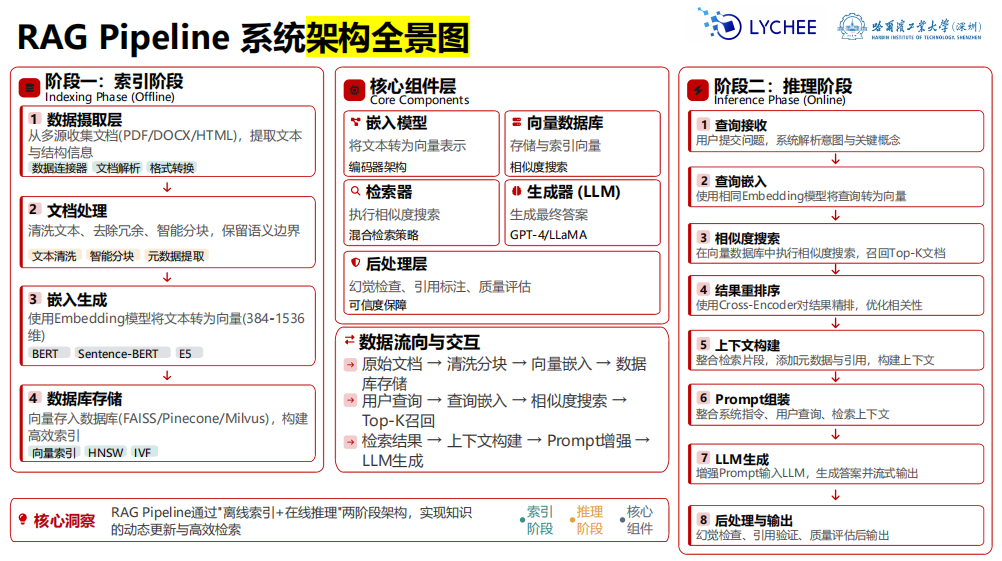
RAG检索增强生成

是将信息检索文本生成深度融合的架构

原理

  • 稀疏检索:关键词匹配与词频统计
  • 稠密检索:词义嵌入向量的相似度匹配
    • 嵌入编码:文本转为低维稠密向量
    • 索引构建:存入向量数据库
    • 相似度检索:余弦相似度,召回Top_k
  1. 编码融合生成:问题与检索文档一同输入编码器
  2. Prompt拼接生成:将检索片段拼接在用户问题Prompt中

整体架构

挑战

  • 检索准确性问题
    • 稀疏+稠密混合检索
    • 重排序模块
    • 查询扩展与改写
  • 多文档融合难度
  • 系统效率瓶颈
  • 知识时效性与更新
  • 可信度与可追溯性
    • 生成、校验
    • 多源验证、置信度评分

代码

导包

1
2
3
4
import numpy as np, torch
from sklearn.feature_extraction.text import TfidfVectorizer
from sklearn.metrics.pairwise import cosine_similarity
from transformers import AutoTokenizer, AutoModelForSeq2SeqLM

构建知识库

共六条:

  • id
  • text

文本切块 chunking

词窗口 + overlap(重叠)

1
2
3
4
5
6
7
8
9
10
11
12
13
14
15
16
17
18
19
20
21
22
23
24
25
26
27
28
29
30
def chunk_text(text,chunk_size=24,overlap=6):
"""
把长文档切分成多个重叠的小文本块(chunk)

- chunk_size:每个chunk最多24单词
- overlap:相邻重叠6个单词

Chunk1: 1 2 3 4 5
Chunk2: 4 5 6 7 8
Chunk3: 7 8 9 10
重叠防止被硬生生截断,而导致检索时丢失语义
"""
w=text.split()
out=[]
s=0
while s<len(w):
e=min(s+chunk_size,len(w))
out.append(' '.join(w[s:e]))
if e==len(w):
break
s=e-overlap
return out

chunks=[]
for d in docs:
for i,ch in enumerate(chunk_text(d['text'])):
chunks.append({'chunk_id': f"{d['id']}_c{i}", 'doc_id': d['id'], 'text': ch})

print('chunks=', len(chunks))
print(chunks[0])

检索器

1
2
3
4
5
6
7
8
9
10
11
12
13
14
15
16
17
18
19
20
# 1.向量化器
vec=TfidfVectorizer(ngram_range=(1,2), lowercase=True) # 包含单词和连续两个,全转为小写
X=vec.fit_transform([c['text'] for c in chunks]) # 转换为向量
# X(chunk数量, 词汇表大小)

# 2.检索
def retrieve(q,top_k=3):
qv=vec.transform([q])
sims=cosine_similarity(qv,X)[0] # 余弦相似度,数值越大,越相关
ids=np.argsort(sims)[::-1][:top_k] # 从高到低,找前 top_k个
out=[]
for i in ids:
item=dict(chunks[i])
item['score']=float(sims[i])
out.append(item)
return out

# 3.使用检索
for h in retrieve('How does LoRA reduce parameters?', 3):
print(h['doc_id'], h['score'])
  • doc_peft: 0.2871094019135437
  • doc_kvcache: 0.0
  • doc_rag: 0.0

加载生成模型

使用flan-t5-small

  • tok
  • model
  • model.eval()

RAG生成函数

1
2
3
4
5
6
7
8
9
10
11
12
13
14
15
16
17
18
19
20
21
22
23
def rag_prompt(q,hits):
ctx="\n".join([f"[{i+1}] {h['text']}" for i, h in enumerate(hits)])
return (
"Answer with retrieved evidence. If insufficient, say insufficient evidence.\n"
f"Question: {q}\nContext:\n{ctx}\nAnswer:"
)

@torch.no_grad()
def generate(prompt,max_new_tokens=96):
x = tok(prompt, return_tensors='pt', truncation=True).to(device)
y = model.generate(
**x,
max_new_tokens=max_new_tokens,
num_beams=4
)
return tok.decode(y[0], skip_special_tokens=True).strip()

def rag_answer(q,top_k=3):
# 找出关联的 chunks
hits = retrieve(q, top_k)
# 构造提示词,并输入大模型
ans = generate(rag_prompt(q, hits))
return {'q': q, 'ans': ans, 'hits': hits}

基线

无检索直接回答

1
2
3
4
5
6
7
8
9
10
11
def direct_answer(q):
return generate(f"Answer briefly.\nQuestion: {q}\nAnswer:")

q = 'Why is retrieval useful in RAG?'
print('direct=', direct_answer(q))

out = rag_answer(q, 3)
print('rag=', out['ans'])

# 打印 Top-k hits
for h in out['hits']: print(h['doc_id'], h['score'])
  • direct = retrieval is useful in RAG.
  • rag = improving factuality and traceability
  • doc_rag:0.23400230699614644
  • doc_kvcache:0.0
  • doc_moe:0.0

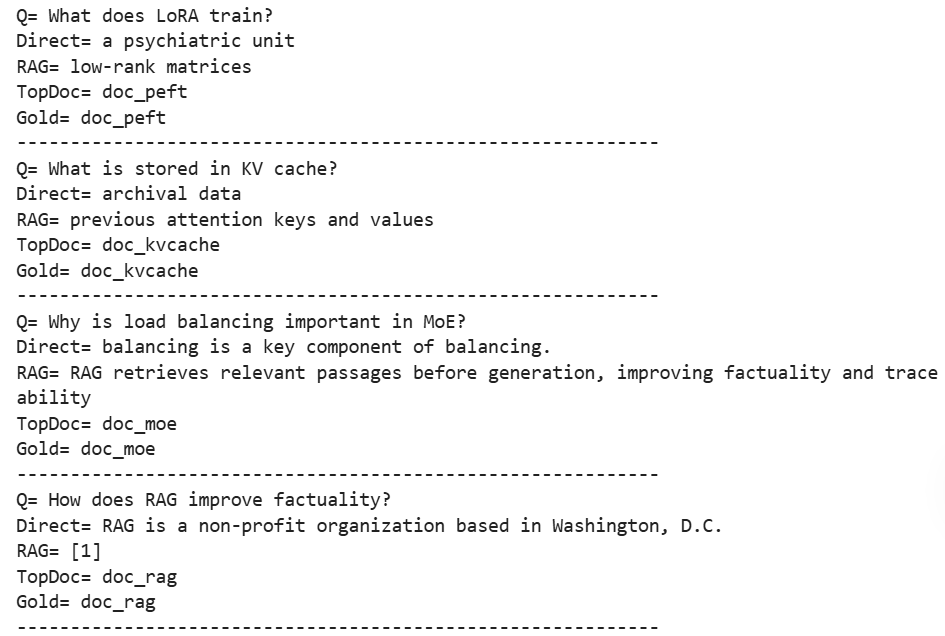
评测集

检索指标

命中率:Hit@k,命中则+1

1
if x['gold'] in doc_ids: hit += 1

可解释证明

打印出分数和文本

留言