LLM_based_10

11k 词

通用信息抽取(IE)与序列标注

概念

信息抽取 lnformation Extraction

分类

信息抽取:非结构化文本到结构化知识的桥梁,是nlp里的任务
任务包括:

  • 命名实体识别(NER):文本中识别出来实体,分类出类型
  • 关系抽取(RE):在实体识别后,找出它们之间的关系类型和关系结构
  • 事件抽取(EE):事件抽取依赖实体抽取和关系抽取

挑战

  • 实体嵌套
  • 非连续实体
  • Schema依赖与零样本:依赖于预先定义的标签集

序列标注协议

标注范式:将抽取任务转化为对序列中每个Token的分类任务

  • BIO:Begin, Inside, Outside
  • BILOU:Begin, Inside, Last, Outside, Unit

应用于:中文分词、词性标注、NER、词法分析、文本加标点

实现技术

  1. 深度学习
  2. 条件随机场(CRF)
    • 发射矩阵:每个词对应什么标签的得分表
    • 转移矩阵:从一个标签转移到另一个标签的得分

解码方法

模型已经给出了每个Token的标签得分(发射矩阵)和标签间的转移规则(转移矩阵),解码算法要做的就是 筛选,找到总得分最高的最优序列

  • 穷举
  • 维特比解码:“局部最优累积”实现“全局最优”
  • 束搜索:贪心策略,每一步仅保留“得分最高的B个候选序列”,B为束宽,减少计算量

image-1

范式转移

从判别式标注到生成式抽取

  • 判别式:受限于预定义标签集
  • 生成式:直接生成结构化文本,跨领域泛化,Schema-free

代码

所用库函数

1
2
3
4
5
6
7
8
9
10
11
12
13
14
import random
import re
import numpy as np
import torch
from datasets import Dataset
from seqeval.metrics import f1_score, classification_report
from transformers import(
AutoTokenizer,
AutoModelForTokenClassification,
DataCollatorForTokenClassification,
TrainingArguments,
Trainer,
pipeline,
)

IE数据构造

我们用“合同/公告/票据”风格文本,实体类型包括:

  • ORG 机构
  • DATE 日期
  • MONEY 金额
  • INVOICE_NO 票据号
  • DOC_TYPE 文档类型
1
2
3
4
5
6
7
8
9
10
11
12
13
14
15
16
17
18
19
20
21
22
23
# 每条样本 token(已分词)+实体跨度(start,end,label)
raw_samples = [
{
'tokens': ['Vendor','BeijingTech','signed','contract','with','ShanghaiCloud','on','2024-03-12','for','1.28M','CNY','.'],
'entities': [(1,2,'ORG'), (5,6,'ORG'), (7,8,'DATE'), (9,11,'MONEY')],
},
{
'tokens': ['Announcement',':','ShenzhenAI','acquired','DataBridge','on','2025-01-15','for','3.2','billion','USD','.'],
'entities': [(0,1,'DOC_TYPE'), (2,3,'ORG'), (4,5,'ORG'), (6,7,'DATE'), (8,11,'MONEY')],
},
{
'tokens': ['Invoice','INV-2024-0312','issued','to','DeltaFactory','amount','98000','CNY','on','2024-03-20','.'],
'entities': [(0,1,'DOC_TYPE'), (1,2,'INVOICE_NO'), (4,5,'ORG'), (6,8,'MONEY'), (9,10,'DATE')],
},
{
'tokens': ['Contract','between','AlphaCompute','and','BetaStorage','effective','2024-07-01','.'],
'entities': [(0,1,'DOC_TYPE'), (2,3,'ORG'), (4,5,'ORG'), (6,7,'DATE')],
},
{
'tokens': ['Invoice','INV-2024-0451','payer','NanoVision','total','120000','CNY','.'],
'entities': [(0,1,'DOC_TYPE'), (1,2,'INVOICE_NO'), (3,4,'ORG'), (5,7,'MONEY')],
},
]

BIO/BILOU标签体系

1
2
3
4
5
6
7
8
9
10
11
12
13
14
15
16
17
18
19
20
21
22
23
24
25
26
27
28
29
30
31
32
33
34
35
36
37
38
39
40
41
42
43
44
45
46
47
48
49
50
51
52
53
# bio
"""
tokens = ["张三","在","北京","工作"]
entities = [(0,1,"PER"), (2,3,"LOC")] # 张三 是 PER,北京 是 LOC
spans_to_bio(tokens,entities)
# 输出: ['B-PER', 'O', 'B-LOC', 'O']
"""
def spans_to_bio(tokens,entities):
tags=['O']*len(tokens) # 全部设置为 O(非实体)
for s,e,label in entities:
tags[s]=f'B-{label}' # 开始 B
for i in range(s+1,e):
tags[i]=f'I-{label}' # 内部 I
return tags

# bilou
"""
bio:B/I/O
bilou:
单字实体 → 用 U-
实体开头 → B-,结尾 → L-
非实体 → O
实体中间 → I-

tags = ['B-PER','O','B-LOC','O']
bio_to_bilou(tags)
# 输出: ['U-PER','O','U-LOC','O']
"""
def bio_to_bilou(tags):
out=[]
for i,t in enumerate(tags):
if t=='O':
out.append('O')
continue
p,label=t.split('-',1) # 拆成 B/I +label
if p =='B':
# 实体,且当前 token是最后一个或下一个 token不以 I开头
single=(i+1==len(tags)) or (not tags[i+1].startswith('I-'))
out.append(f'U-{label}' if single else f'B-{label}')
elif p == 'I':
# 内部,且最后,且不以 I
last = (i+1 == len(tags)) or (not tags[i+1].startswith('I-'))
out.append(f'L-{label}' if last else f'I-{label}')
else:
out.append(t)
return out

# 使用bio和bilou
processed=[]
for s in raw_samples:
bio=spans_to_bio(s['tokens'],s['entities'])
bilou=bio_to_bilou(bio)
processed.append({'tokens':s['tokens'],'bio':bio,'bilou':bilou})

组装Dataset和标签映射

1
2
3
4
5
6
7
8
9
10
11
12
13
14
15
16
17
18
19
20
21
22
23
24
25
26
"""
1.打乱样本
2.按比例划分训练/验证集
3.构建标签映射
4.转换成模型输入格式
5.用 HuggingFace Dataset 构建训练/验证集对象
"""
random.shuffle(processed)
sp=int(len(processed)*0.8) # 训练集 80%
train_samples,val_samples=processed[:sp],processed[sp:] # 8:2

# 收集bio标签的集合,先取s,再t满足
label_list=sorted({t for s in processed for t in s['bio']})
# 标签 - id
label2id={t:i for i,t in enumerate(label_list)}
# id - 标签
id2label={i:t for t,i in label2id.items()}

def to_rows(samples):
return [{
'tokens':s['tokens'],
'ner_tags':[label2id[t] for t in s['bio']]
} for s in samples]

train_ds=Dataset.from_list(to_rows(train_samples))
val_ds=Dataset.from_list(to_rows(val_samples))

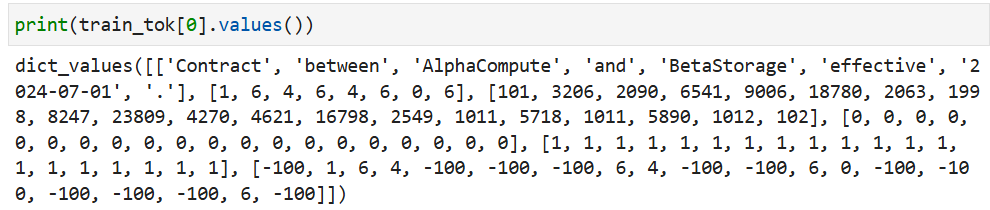
Tokenization+Label对齐

切分子词后,非首+特殊:-100,避免参与损失

对齐:把原来的标签对应到更小单位上

原词序列: 张三 在 北京 工作

1
2
3
4
5
6
7
8
9
10
11
12
13
14
15
16
17
18
19
20
21
22
23
24
25
26
27
28
29
30
31

▼ BERT Tokenizer (subword) 进行分词

subwords: [CLS] 张 ##三 在 北 ##京 工 ##作 [SEP]


▼ 标签对齐 (align)

aligned_labels: -100 1 -100 0 2 -100 0 -100 -100


▼ 模型输出 logits

pred_ids: - 1 1 0 2 2 0 0 -


▼ 去掉 -100

有效 subwords: 张 在 北 工
labels/preds: 1,0,2,0 / 1,0,2,0


▼ 转成可读标签

y_true: ['B-PER', 'O', 'B-LOC', 'O']
y_pred: ['B-PER', 'O', 'B-LOC', 'O']


▼ F1 计算

F1 = 1.0
1
2
3
4
5
6
7
8
9
10
11
12
13
14
15
16
17
18
19
20
21
22
23
24
25
26
27
28
29
30
31
32
33
34
35
36
37
38
39
40
41
42
43
44
45
46
47
48
49
50
51
52
53
54
from transformers import BertTokenizer

MODEL='./models/bert-tiny'

"""
BertTokenizer vs AutoTokenizer
1.BertTokenizer
针对bert模型,vocab.txt,慢速,无需tokenizer
2.AutoTokenizer
通用接口,默认会尝试 fast tokenizer,支持 .word_ids() 方法 → 子词对齐方便
"""
tok=BertTokenizer.from_pretrained(MODEL)

# 对齐函数
def align(batch):
"""
loss只计算subword的第一个token

1.用 tokenizer 把词拆成 subwords
2.给每个 subword 一个标签:
(1 词的第一个 subword → 保留原来的标签
(2 其他 subword → 用 -100 忽略(PyTorch loss 会自动跳过)
3.返回对齐后的 input_ids、attention_mask 和 labels

tokens = ["张三", "在", "北京", "工作"]
ner_tags = [0, 1, 2, 1] # 用数字代替 B/I/O

subwords = ["[CLS]", "张", "##三", "在", "北", "##京", "工", "##作", "[SEP]"]
word_ids = [None, 0, 0, 1, 2, 2, 3, 3, None]
"""
# batch:词列表
# is_split_into_words:每个输入是一个词、超长截断
# truncation:超长截断
z=tok(batch['tokens'],is_split_into_words=True,truncation=True)
labels=[]
for i,lab in enumerate(batch['ner_tags']):
word_ids=z.word_ids(batch_index=i)
cur=[]
prev=None
for wid in word_ids:
if wid is None:
cur.append(-100)
elif wid != prev:
cur.append(lab[wid]) # 第一个
else:
cur.append(-100) # 后面的
prev=wid
labels.append(cur)
z['labels']=labels
return z

train_tok=train_ds.map(align,batched=True)
val_tok=val_ds.map(align,batched=True)
print(train_tok[0].keys())

image-2

训练轻量NER模型

1
2
3
4
5
6
7
8
9
10
11
12
13
14
15
16
17
18
19
20
21
22
23
24
25
26
27
28
29
30
31
32
33
34
35
36
37
38
39
40
41
42
43
44
45
46
47
48
49
50
51
52
53
54
55
56
57
58
59
60
61
62
63
64
65
66
67
68
69
70
71
72
73
from transformers import BertForTokenClassification

"""
模型:BERT-tiny + TokenClassification 输出层
数据:子词对齐后的 train_tok / val_tok
指标:只计算有效 token 的 F1
Trainer:封装训练、评估、batch、padding、梯度更新
注意点:
分类层随机初始化 → 训练时会更新
子词对齐很重要,否则 loss 会计算错
batch size 太小会影响训练速度,但 tiny 模型可以跑
"""

model = BertForTokenClassification.from_pretrained(
MODEL, num_labels=len(label_list), id2label=id2label, label2id=label2id
)
# 数据整理器:统一成张量,自动 padding
collator = DataCollatorForTokenClassification(tok)

# 指标函数
def compute_metrics(eval_pred):
logits, labels = eval_pred
preds = np.argmax(logits, axis=-1)
# 这里得到预测概率向量
y_pred, y_true = [], []
for p_seq, l_seq in zip(preds, labels):
cur_p, cur_t = [], []
for p, l in zip(p_seq, l_seq):
# 非首词、[CLS]、[SEP] 标签是 -100,跳过
if l == -100:
continue
# 从向量label转向之前的 O、B-PER这些
cur_p.append(id2label[int(p)])
cur_t.append(id2label[int(l)])
y_pred.append(cur_p)
y_true.append(cur_t)
return {'f1': f1_score(y_true, y_pred)}

import inspect

ta_kwargs = dict(
output_dir='./tmp/ch10_ie',
learning_rate=5e-5,
per_device_train_batch_size=4,
per_device_eval_batch_size=4,
num_train_epochs=8,
save_strategy='no',
logging_strategy='epoch',
report_to='none',
fp16=torch.cuda.is_available(),
)

# 自动判断参数名,inspect用来兼容不同版本的Transformer
sig = inspect.signature(TrainingArguments.__init__).parameters
if 'evaluation_strategy' in sig:
ta_kwargs['evaluation_strategy'] = 'epoch'
else:
ta_kwargs['eval_strategy'] = 'epoch'

args = TrainingArguments(**ta_kwargs)

# 封装训练
trainer = Trainer(
model=model,
args=args,
train_dataset=train_tok,
eval_dataset=val_tok,
data_collator=collator,
compute_metrics=compute_metrics,
)

trainer.train()
print(trainer.evaluate())

基于NER的关系抽取(RE)

1
2
3
4
5
6
7
8
9
10
11
12
13
14
15
16
17
18
19
20
21
22
23
24
25
26
27
# NER推理与结果可视化
ner=pipeline('token-classification',model=model,tokenizer=tok,aggregation_strategy='simple')
# aggregation_strategy 定义如何把子词的预测结果合并为 一个完整词的预测:
# 相邻子词预测相同类别的 token 合并为一个实体。
text = 'Contract between BeijingTech and ShanghaiCloud on 2025-03-01 for 450000 CNY.'
ents=ner(text) # 提取出实体
print('text:',text)
for e in ents:
print(e)

"""
这里用最小规则演示(便于理解链路)。生产中可替换为 RE 模型或 LLM 指令抽取。
"""
def extract_relations(txt,ents):
orgs=[e for e in ents if e.get('entity_group')=='ORG']
dates = [e for e in ents if e.get('entity_group') == 'DATE']
moneys = [e for e in ents if e.get('entity_group') == 'MONEY']
rel=[]
# 合同关系:文本包含 contract,至少两个公司实体
if 'contract' in txt.lower() and len(orgs) >= 2:
rel.append({'head': orgs[0]['word'], 'rel': 'CONTRACT_WITH', 'tail': orgs[1]['word']})
# 金额生效关系:有日期和金钱
if dates and moneys:
rel.append({'head': moneys[0]['word'], 'rel': 'EFFECTIVE_ON', 'tail': dates[0]['word']})
return rel

print(extract_relations(text, ents))

文档字段抽取(票据/发票)

演示“规则抽取”作为基线,真实项目可升级为 LLM 结构化抽取。

1
2
3
4
5
6
7
8
9
10
11
invoice = 'Invoice No: INV-2025-2331; Buyer: NanoVision; Amount: 268000 CNY; Date: 2025-04-19'

def parse_invoice(t):
return{
'invoice_no': (re.search(r'INV-\d{4}-\d{4}', t).group(0) if re.search(r'INV-\d{4}-\d{4}', t) else None),
'buyer': (re.search(r'Buyer:\s*([A-Za-z][A-Za-z0-9_-]+)', t).group(1) if re.search(r'Buyer:\s*([A-Za-z][A-Za-z0-9_-]+)', t) else None),
'amount_cny': (float(re.search(r'(\d+(?:\.\d+)?)\s*CNY', t).group(1)) if re.search(r'(\d+(?:\.\d+)?)\s*CNY', t) else None),
'date': (re.search(r'\d{4}-\d{2}-\d{2}', t).group(0) if re.search(r'\d{4}-\d{2}-\d{2}', t) else None),
}

print(parse_invoice(invoice))

详细报告

1
2
3
4
5
6
7
8
9
10
11
12
13
14
15
16
17
18
19
20
21
22
23
24
25
26
27
preds=trainer.predict(val_tok)
pred_ids=np.argmax(preds.predictions,axis=-1)

y_true,y_pred=[],[]
"""
logits转换为标签id,忽略padding和非首词
id转换成原始标签
"""
for p_seq,l_seq in zip(pred_ids,preds.label_ids):
cur_t,cur_p=[],[]
for p,l in zip(p_seq,l_seq):
if l==-100:
continue
cur_t.append(id2label[int(l)])
cur_p.append(id2label[int(p)])
y_true.append(cur_t)
y_pred.append(cur_p)

"""
输出每个标签的:

1.precision(精确率)
2.recall(召回率)
3.f1-score
4.support(每个标签出现次数)
"""
print(classification_report(y_true, y_pred, digits=4)) # 精确到小数点后四位
留言